
Execution-ready governance framework with AI-assisted oversight for public institutions, multilateral programmes and complex organisational environments.
A governance methodology and institutional model designed to turn reform intent into structured, measurable execution — with AI used strictly as an analytical augmentation layer under institutional control.
The framework is relevant where complex environments suffer from fragmentation, unclear ownership, weak oversight logic or the absence of a credible mechanism to connect mandate with execution.
It functions as a Single Point of Institutional Clarity: enabling leadership to maintain authority while improving visibility, coordination and evidence-based decision-making across complex organisations.
Developed as an operational governance methodology, the framework has been applied through analytical simulations across diverse regulatory and institutional environments and continues to be refined.
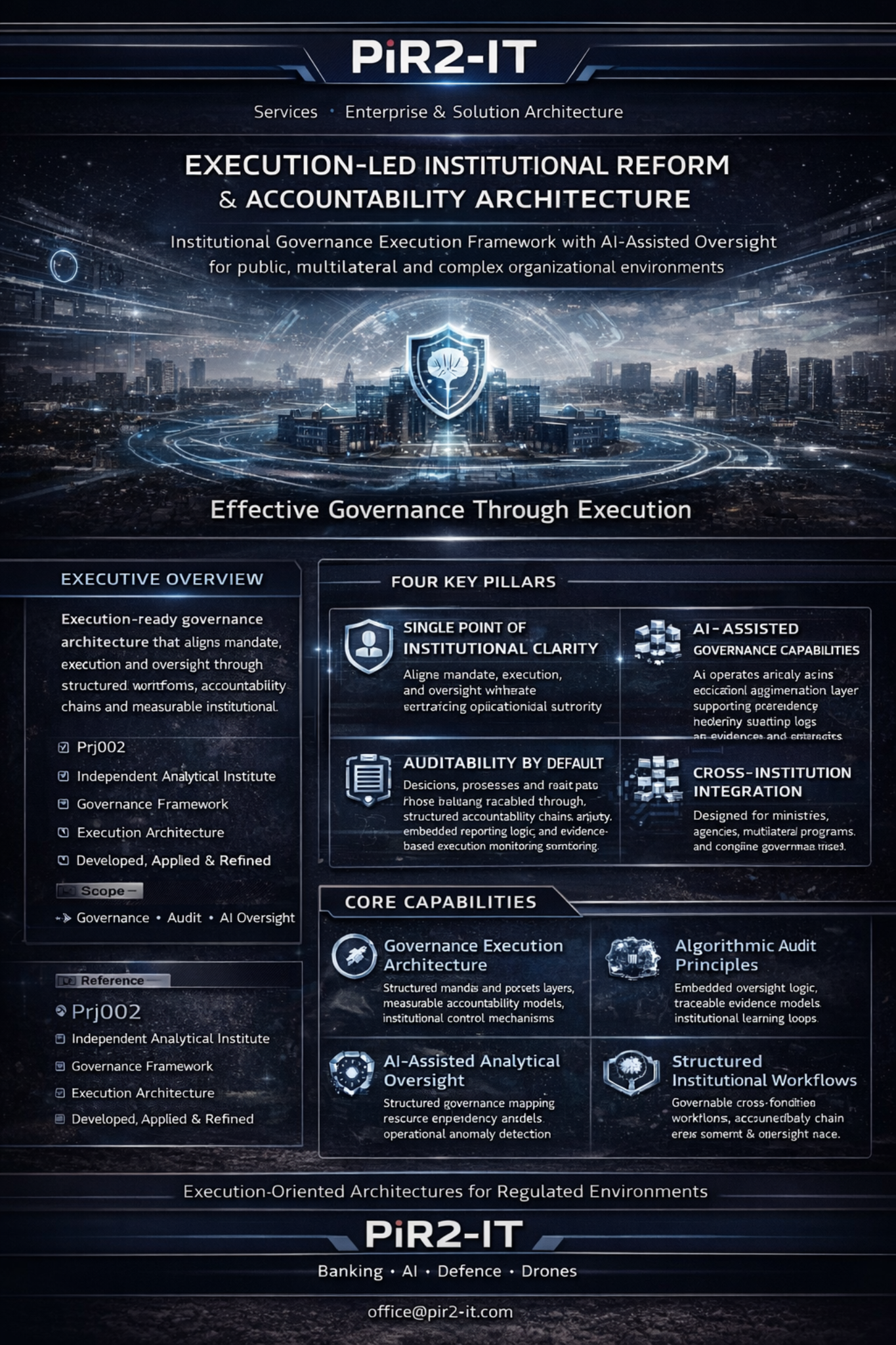
A governance layer that aligns mandate, execution and oversight without centralising operational authority — enabling leadership to maintain control while delegating effectively.
Decisions, processes and resource flows become traceable through structured accountability chains, embedded reporting logic and evidence-based execution monitoring.
AI operates strictly as an analytical augmentation layer — dependency mapping, anomaly detection, accountability-chain analysis and workflow optimisation — all reviewable and institutionally controlled.
The framework is designed for ministries, agencies and multilateral programmes where authority, workflows and oversight requirements are complex and politically sensitive.
Developed as an operational governance methodology and applied through analytical simulations across regulatory, multilateral and public institutional environments. The framework is continuously refined based on real programme conditions and governance challenges.
Discuss how this architecture or methodology applies to your programme, sector or challenge.
