
PiR2-ITService • Enterprise & Solution Architecture

DLT, AI, Zero Trust and digital public infrastructure architecture for trusted, auditable and interoperable government services at national scale.
Why digital government succeeds or fails on trust, not technology. Across governments and international institutions, digital transformation is no longer limited by technology availability. Cloud, AI and automation are mature. What remains difficult is trust — trust in data integrity, decisions, access control, auditability and fairness.
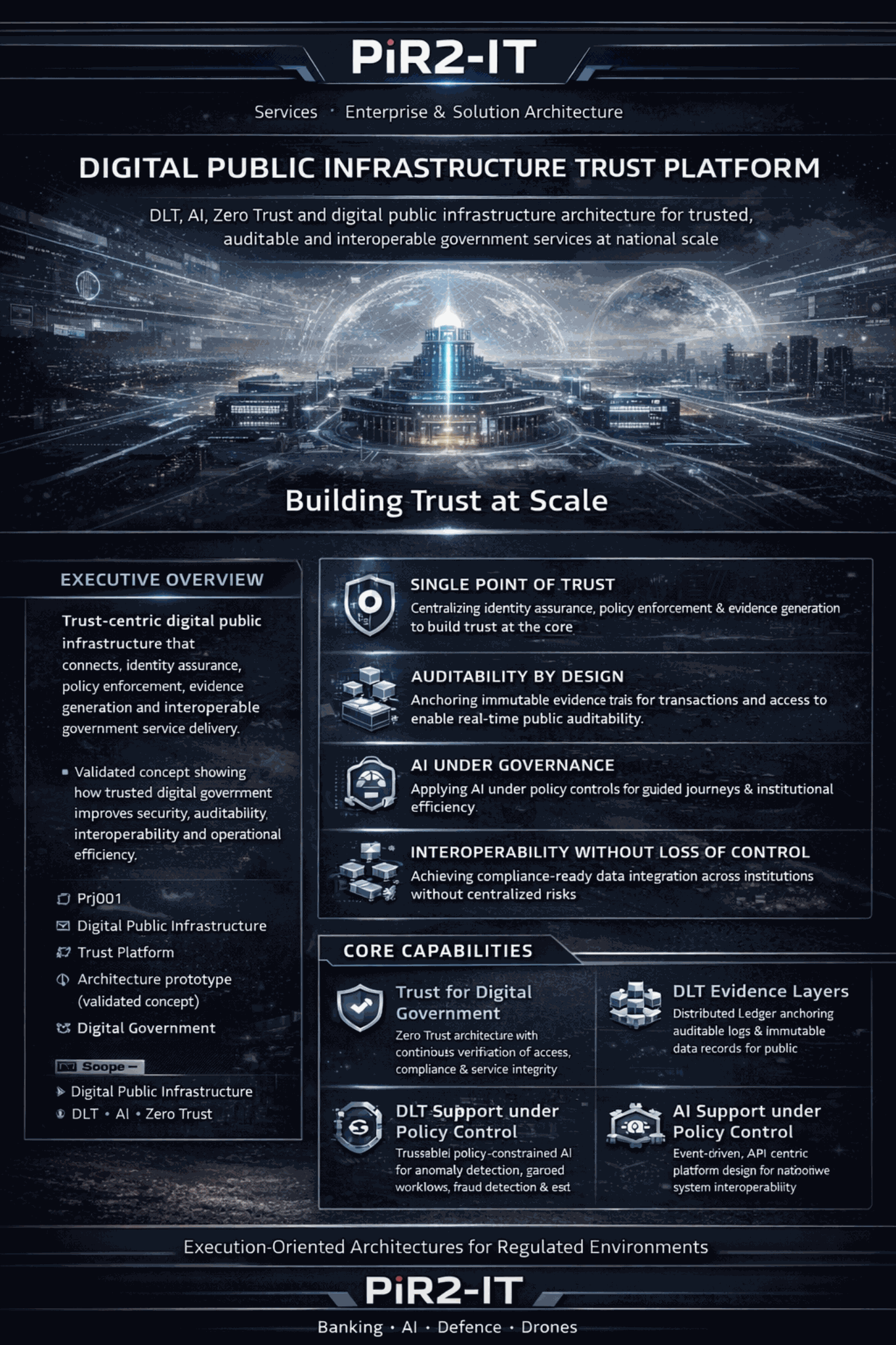
What it covers. Traditional eGovernment platforms often replicate institutional silos in digital form, creating fragmented accountability and weak audit trails. This prototype introduces a Single Point of Trust — not by centralizing data, but by centralizing identity assurance, policy enforcement, evidence generation and service integrity.
Distributed Ledger Technology. DLT is used to anchor immutable evidence trails for transactions, access and decisions, supporting compliance, dispute resolution and public accountability.
Engagement value. In a European government implementation context, this architecture model contributed to a transformational public-sector programme that materially improved security, reduced duplication and raised institutional trust in digital service delivery.
In regulated environments, transparency must be provable. The platform therefore embeds auditability, governance and evidence generation directly into architecture rather than relying on post-hoc reconstruction or policy statements alone.
 Single Point of Trust
The prototype treats trust as a system property rather than a policy statement by centralizing the trust functions that matter most: identity assurance, policy enforcement, evidence generation and service integrity.
 Auditability by design
Distributed Ledger Technology anchors immutable evidence trails for transactions, access and decisions, enabling verifiable receipts, traceable service states and real-time audit readiness.
 AI under governance
AI is applied only where it reduces burden without undermining accountability, supporting guided digital journeys, anomaly detection, case routing and explainable operational analytics.
 Interoperability without loss of control
Legacy systems, APIs, event-driven patterns and cross-institution workflows are integrated under controlled compliance rules so services can scale without weakening accountability.
The platform generates immutable logs and decision records, verifiable receipts for citizens and institutions, and traceable service states across integrated systems. This eliminates the need for post-hoc forensic reconstruction and enables real-time audit readiness — a critical requirement for courts, regulators, donors and oversight bodies.
AI is applied where it delivers operational value without undermining accountability.
Security is implemented as a continuous process, not a perimeter. Core principles include strong identity and continuous authorization, least privilege and segmentation, policy-as-code enforcement, and tamper-evident logging and observability. This enables secure interaction across citizens, institutions, suppliers and legacy systems — without implicit trust assumptions.
The architecture is designed for broad service coverage, integrating legacy and modern e-services, APIs and event-driven patterns, and cross-institution workflows. Interoperability is treated as a controlled compliance activity, preserving accountability while enabling end-to-end digital processes.
The concept aligns with digital public infrastructure and public-sector trust architecture principles relevant to regulated government environments.
In a European country implementation context, the architecture was applied to a government-scale digital transformation effort where fragmented records, duplicated workflows, inconsistent access control and weak evidence trails were limiting service quality and public confidence.
By restructuring the platform around digital public infrastructure principles, DLT-backed evidence, Zero Trust controls and policy-bounded AI support, the implementation materially improved operational resilience and public-service governance.
Why this matters. Public trust in digital government is fragile. Every opaque decision, data breach or untraceable process erodes legitimacy. This prototype demonstrates that it is possible to deliver scalable digital services, strong security and auditability, AI-enabled efficiency and citizen-centric transparency — without trading accountability for convenience. Digital government does not need to be faster or safer. With the right architecture, it can be both.