
PiR2-ITService • Enterprise & Solution Architecture

Architecture-first AI-enabled unmanned systems demonstrator designed for regulated, high-trust operational environments.
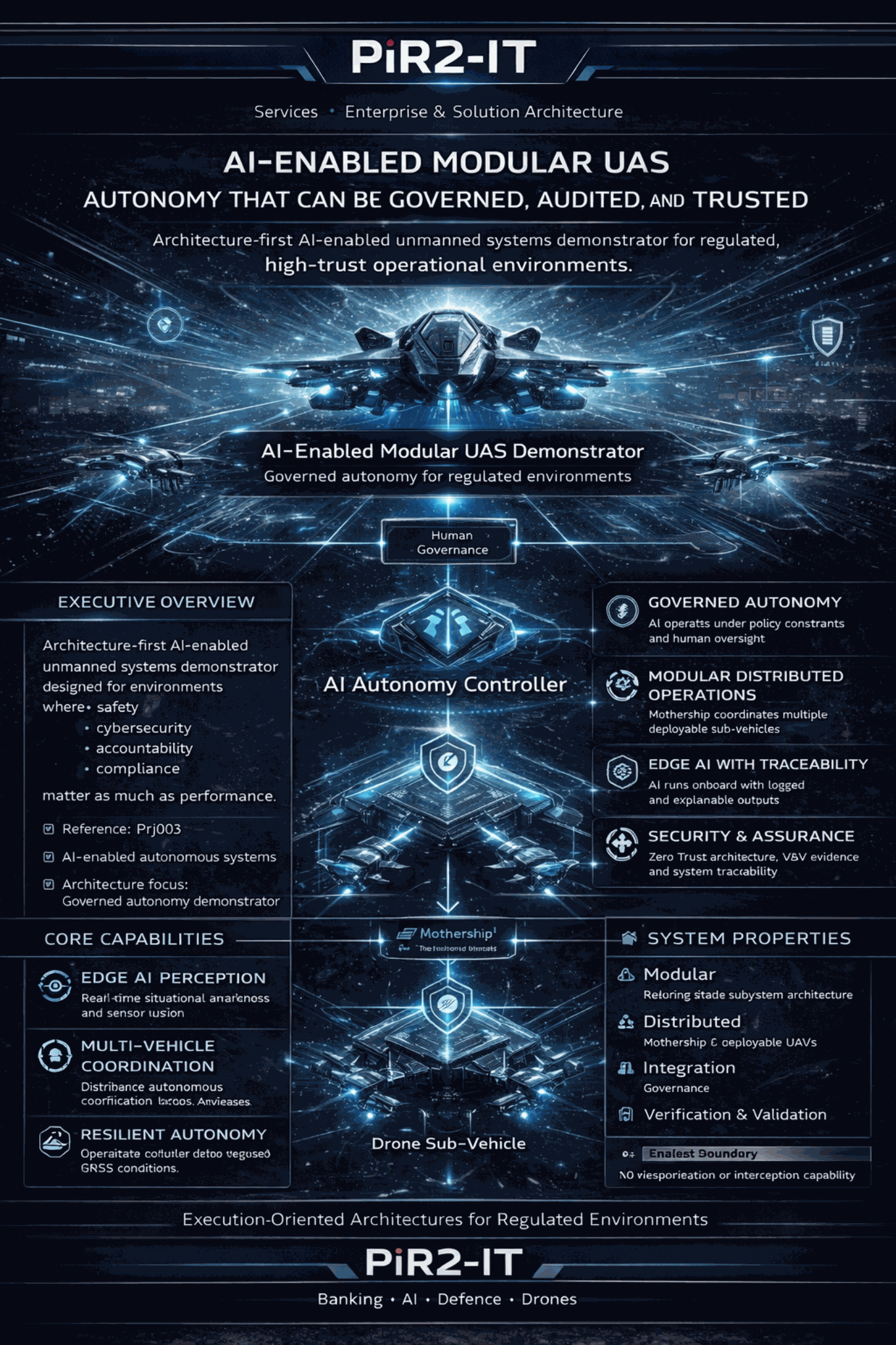
Why autonomy in regulated environments is an engineering problem — not a buzzword. At PiR2-IT, we approached this challenge by designing and testing a modular AI-enabled UAS demonstrator built around a mothership coordinating multiple deployable sub-vehicles — with governance, resilience and evidence built in from day one.
Delivery boundary. The project focuses strictly on architecture, AI systems engineering, cybersecurity, integration, governance and assurance. It does not include weaponization or interception. That boundary is explicit, documented and enforced.
What it covers. The demonstrator explores how advanced autonomy can remain powerful without being opaque, and autonomous without being unaccountable, in high-trust and mission-grade environments.
Engagement value. The architecture demonstrates how AI-enabled unmanned systems can be engineered for trust, reviewability and resilient delivery rather than novelty alone.
The demonstrator treats unmanned systems as engineered socio-technical systems where AI operates under policy constraints and human governance.
 From smart drones to accountable systems
The demonstrator is not about autonomy for autonomy’s sake. It treats unmanned systems as engineered socio-technical systems where AI must operate under policy constraints and human governance.
 Modular by design and distributed operations
A mothership coordinates multiple deployable sub-vehicles, scaling sensing coverage and tasking flexibility through modular subsystem boundaries and distributed operations rather than central fragility.
 Edge AI with governance, not black boxes
AI is embedded onboard at the edge for perception, routing, task support, anomaly detection and predictive health monitoring, while outputs remain logged, traceable and explainable enough for review.
 Security, assurance and interoperability
Threat-informed design, Zero Trust principles, V&V evidence, configuration baselines and interoperability considerations are integrated as first-class concerns, not afterthoughts.
AI is embedded where it delivers the most value: onboard, at the edge.
Crucially, AI outputs are designed for review: logged, traceable and explainable enough to support oversight and post-event analysis.
The architecture integrates security-by-design and verification & validation as first-class concerns.
The project focuses strictly on architecture, AI systems engineering, cybersecurity, integration, governance and assurance. It does not include weaponization or interception. That boundary is explicit, documented and enforced.
Why this matters. As AI and autonomy move into critical infrastructure, security and mission-grade domains, success will depend less on novelty — and more on trust. Trust is built through governed autonomy, audit-ready evidence, resilient engineering and clear accountability.