
PiR2-ITService • Engineering Prototyping

Technical prototyping, validation architecture and secure engineering workflows designed to turn complex concepts into working systems under controlled and trusted development conditions.
What it covers. Engineering prototyping spans system architecture experiments, hardware-software integration, algorithm validation, operational simulation and prototype system packaging. The work includes technical experimentation, validation scenarios, prototype system architecture and performance analysis designed to determine whether a concept can operate in real-world conditions.
Why it matters. Many advanced technology ideas fail because validation occurs too late or under uncontrolled conditions. Engineering prototyping enables organizations to explore technical feasibility early, uncover system constraints, test operational assumptions and reduce uncertainty before committing to large-scale implementation.
Typical deliverables. Prototype platforms, experimental architectures, system demonstrators, simulation environments and feasibility evidence that allow concepts to be tested before scaled investment.
Engagement value. This service is especially valuable for advanced systems, AI platforms, autonomy concepts, cyber-physical engineering and innovation programmes where technical clarity must emerge quickly without losing process discipline, trust and security controls.
PiR2-IT develops advanced prototypes and technical demonstrators that validate architecture, product concepts and technology feasibility before full-scale delivery investment. The objective is to reduce uncertainty, accelerate learning and make engineering decisions visible early.
 Advanced prototype design
Structured prototype development used to validate product concepts, architecture assumptions and technical feasibility in controlled conditions.
 Autonomous systems engineering
Prototype architectures for AI-enabled, modular and cyber-physical systems where interaction between hardware, software and control logic must be tested early.
 Secure partner-led prototyping
Prototypes can be executed at client request, based on PiR2-IT ideas or on partner concepts under trusted, controlled and security-aware development conditions.
 Prototype validation and simulation
Disciplined validation using system testing, simulation scenarios, operational modelling and technical verification before a prototype is considered viable.
PiR2-IT prototyping work combines concept engineering, validation cycles and architecture testing models used across advanced technical environments.
PiR2-IT prototypes are developed under structured engineering processes that emphasize security, operational reliability and controlled experimentation. Prototypes may be executed at client request, based on PiR2-IT ideas or on partner concepts where trust, security and controlled development conditions are essential.
Engineering work follows disciplined validation procedures including simulation scenarios, system testing, operational modelling and technical verification before a prototype is considered viable.
In one advanced engineering engagement, PiR2-IT developed a modular unmanned aerial system prototype using repurposed laptop components and a highly customized operating system optimized for autonomous drone coordination. The concept demonstrated how low-cost hardware combined with specialized software architecture could support advanced autonomous capabilities under controlled and trusted engineering conditions.
The prototype supported a single drone or a coordinated swarm with master and slave drones operating at different altitudes, autopilot-to-target logic, AI-assisted target detection, fire-avoidance behaviour, deviation correction based on trajectory and weather, GPS-degraded navigation, operation in signal-degraded environments, coordinated mission execution and optimized cost architecture based on repurposed hardware.
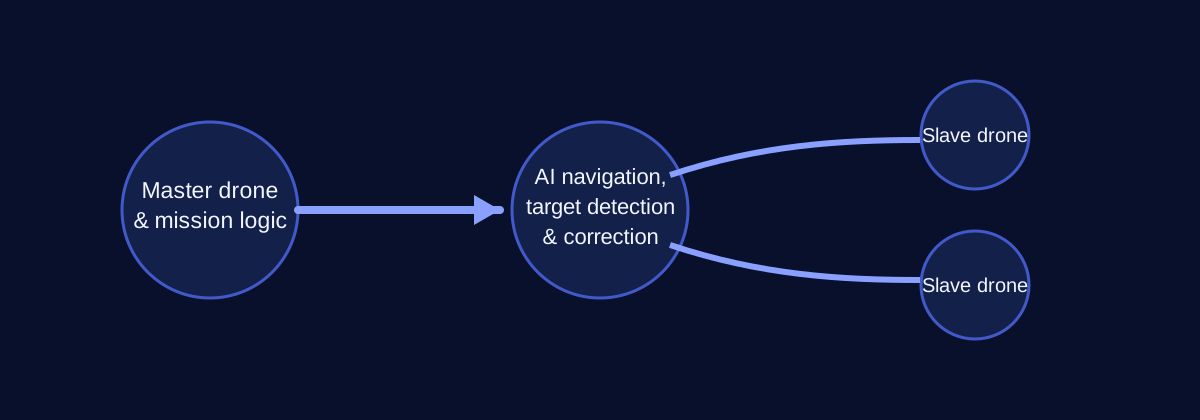
Why this matters. The prototype demonstrated that advanced autonomous drone capabilities can be achieved through optimized system architecture rather than expensive specialized hardware. The master-slave swarm model enabled coordinated multi-drone operation across different altitudes while maintaining centralized mission logic and distributed execution. The approach showed that cost-efficient hardware, specialized operating systems and AI-assisted control can significantly reduce cost while preserving operational effectiveness.